
For many homeowners, the mortgage payment is one of the largest monthly expenses. When there is extra cash available, one common question is whether it should be saved, invested, used for other expenses, or applied toward the mortgage.
There is no single answer that applies to everyone, but even small mortgage prepayments can make a meaningful difference over time. Depending on your mortgage product, payment privileges, and financial goals, paying a little extra toward your mortgage may help reduce interest costs and shorten the time it takes to become mortgage-free.

How small mortgage prepayments can help
When you make an extra payment toward your mortgage principal, you reduce the balance on which future interest is calculated. Over time, this can help you save interest and pay down the mortgage faster.
For example, on a larger mortgage balance, even a small increase in payments or an annual lump-sum payment can create long-term savings. The exact impact depends on your mortgage amount, rate, amortization, payment frequency, and the prepayment options allowed by your lender.
Three common ways to pay your mortgage faster
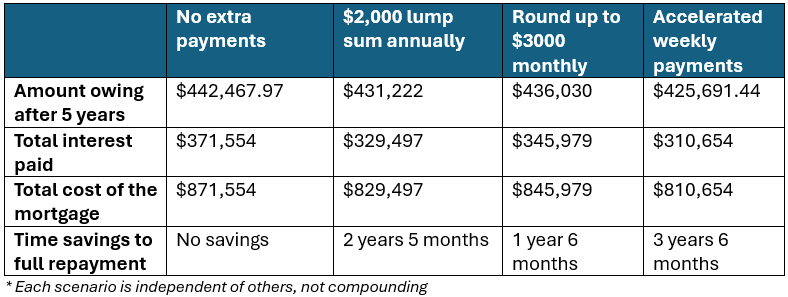
Most homeowners who want to reduce their mortgage faster usually use one or more of these strategies:
1. Make a lump-sum payment
Some mortgage products allow you to make one or more lump-sum payments during the year. This can be useful if you receive a bonus, tax refund, commission, inheritance, or other extra funds.
The amount you can prepay depends on your lender’s rules. Some lenders allow a percentage of the original mortgage amount or outstanding balance, while others have different limits.
2. Increase or round up your regular payments
Another simple option is to increase your regular payment amount. For example, you may choose to round your payment up to the nearest $50, $100, or another amount that fits your budget.
This strategy can be easier for homeowners who prefer a consistent monthly habit instead of making one large payment.
3. Use accelerated payments
Accelerated weekly or accelerated bi-weekly payments can also help reduce the mortgage faster. With this option, you make payments more frequently, which can reduce interest over time and shorten the amortization.
This option is often attractive for borrowers who are paid weekly or bi-weekly and want their mortgage payments to match their income schedule.
Before making extra payments, check your mortgage conditions
Before making a prepayment, it is important to confirm what your mortgage allows. Not every mortgage product has the same flexibility.
You should verify:
- How much you can prepay each year
- Whether you can increase your regular payment
- Whether accelerated payments are available
- If there are penalties for exceeding the allowed prepayment amount
- Whether your current mortgage is flexible enough for your goals
This is one reason why the lowest rate is not always the best mortgage. A mortgage with better flexibility may be more valuable if you plan to make extra payments, sell, refinance, or renew before the end of the term.
Economic Insights from Dr. Sherry Cooper
The following housing market outlook is based on the economic commentary from Dr. Sherry Cooper, Chief Economist at Dominion Lending Centres.

Outlook for the Canadian housing market in 2026 and 2027
According to Dr. Sherry Cooper’s economic commentary, Canada’s housing market is expected to move through a period of gradual recovery and adjustment in 2026 and 2027.
After several years of higher interest rates, affordability pressure, and uneven regional performance, the market is more likely to stabilize gradually than to return quickly to the very strong conditions seen during the pandemic years.
Lower policy rates may support some improvement in affordability, but market-determined interest rates, inflation expectations, economic uncertainty, and global developments can still affect borrowing costs for households.
Quebec may remain more stable than some other markets
Housing conditions vary across Canada. Some higher-cost markets, especially in parts of Ontario and British Columbia, may continue to face more pressure due to affordability challenges and weaker investor demand.
Quebec has shown more stability compared with some other regions, supported by relatively lower average prices and a broader mix of housing types. Even so, buyers and homeowners should still be careful, because mortgage qualification, rates, income, credit, and property type all matter.
Housing supply remains a long-term challenge
One of the key issues in Canada’s housing market remains supply. Even if demand slows in some regions, Canada continues to face a long-term need for more housing.
Construction costs, financing costs, labour shortages, and project delays can all affect the pace of new housing supply. This is especially important for buyers, renters, and policymakers because supply has a direct impact on long-term affordability.
What this means for homeowners
If you already own a home, this is a good time to review your mortgage strategy. If your mortgage is coming up for renewal, do not wait until the last minute or simply accept the first offer from your current lender.
You may want to compare:
- Fixed and variable mortgage options
- Payment flexibility
- Prepayment privileges
- Penalty conditions
- Refinancing or debt consolidation options
- Whether your current mortgage still fits your financial situation
Bottom Line
Small mortgage prepayments can create meaningful savings over time, but the best strategy depends on your mortgage terms, lender rules, and personal financial situation.
The Canadian housing market is also expected to move through a more cautious recovery, with conditions varying by region and property type. For homeowners and buyers, the most important step is preparation.
If your goal is to pay your mortgage faster, reduce interest, renew your mortgage, or refinance, it is important to review the full mortgage strategy — not only the rate.
Thinking about paying your mortgage faster, renewing, or refinancing?
I can help you review your options and understand what strategy may fit your situation.
Ready to Review Your Mortgage Options?
Whether you are buying, renewing, or refinancing, I can help you understand your numbers and compare mortgage options.
Economic outlook reference: Dr. Sherry Cooper, Chief Economist at Dominion Lending Centres. This article is for general information only and should not be considered financial advice. Mortgage options, prepayment privileges, approval, penalties, and refinancing conditions depend on the lender, mortgage product, income, credit, debts, property type, and documents.